
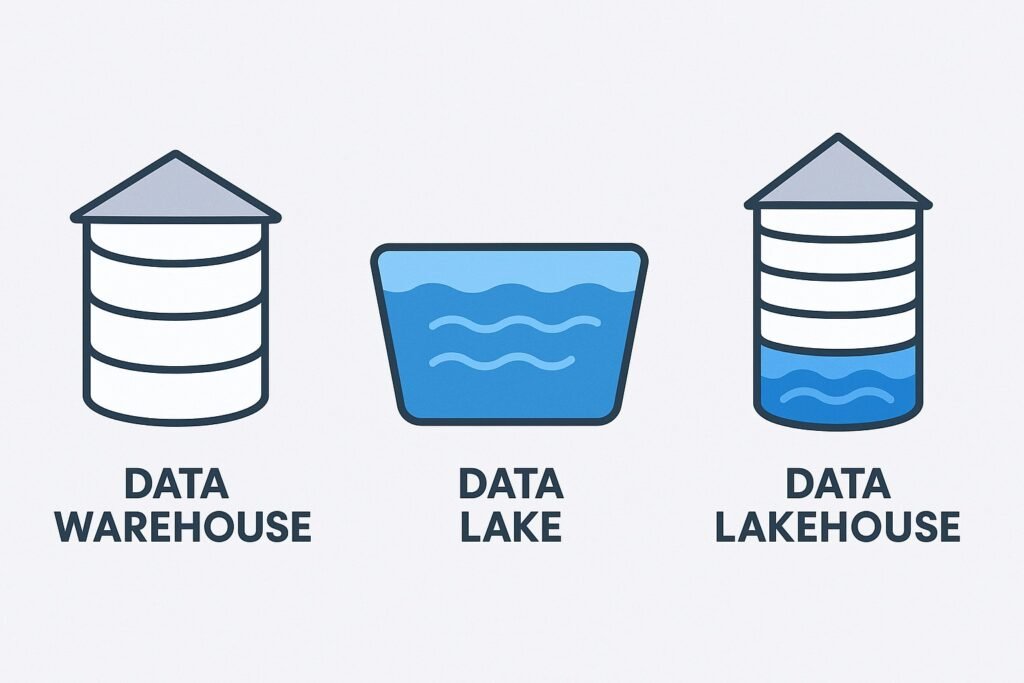
Modern data platforms evolve fast, and so do the terms we use to describe them. “Data lake,” “data warehouse,” and “lakehouse” often get thrown around interchangeably, but they represent very different architectural approaches. Understanding these differences is essential for designing scalable, reliable, and cost‑effective data systems.
This article breaks down each architecture in a simple, practical way — focusing on what they are, how they work, and when to use them.
Why These Terms Matter
Every organisation wants to extract value from data, but the path to doing that depends heavily on how the data is stored, processed, and governed.
The three architectures differ in:
- Structure
- Cost
- Performance
- Governance
- Use cases
Choosing the right one can determine whether your data platform becomes a strategic asset or a technical bottleneck.
1. Data Lake — The Flexible Foundation
A data lake is a large, low‑cost storage system that accepts any type of data in its raw form. It’s built for scale and flexibility, not structure.
What Goes Into a Data Lake
- Structured data (tables, CSVs)
- Semi‑structured data (JSON, logs, clickstreams)
- Unstructured data (images, audio, PDFs)
Key Characteristics
- Schema‑on‑read: Structure is applied only when data is queried
- Massive scalability: Ideal for petabyte‑scale workloads
- Low cost: Uses object storage (S3, ADLS, GCS)
Strengths
- Perfect for machine learning and exploratory analytics
- Easy ingestion from diverse sources
- Minimal upfront modelling
Challenges
- Can become a “data swamp” without governance
- Slower performance for SQL analytics
- Harder for business users to consume
A data lake is ideal when you want to store everything first and decide how to use it later.
2. Data Warehouse — The Trusted Analytics Engine
A data warehouse is a structured, curated environment optimised for fast SQL queries and business intelligence.
What Makes a Warehouse Different
- Schema‑on‑write: Data is cleaned and modelled before loading
- ACID transactions: Ensures consistency and reliability
- High‑performance compute: Designed for analytical workloads
Strengths
- Reliable, governed, high‑quality data
- Excellent for dashboards, KPIs, and reporting
- Strong security and access controls
Challenges
- More expensive than a data lake
- Not suitable for raw or unstructured data
- Requires upfront modelling and ETL work
Warehouses shine when the business needs consistent, trusted data for decision‑making.
3. Lakehouse — The Unified Architecture
A lakehouse combines the best parts of data lakes and data warehouses.
It sits on top of a data lake but adds the reliability, performance, and governance traditionally found in warehouses.
What Makes a Lakehouse Powerful
- ACID transactions on top of object storage
- Schema enforcement and governance
- Time travel and versioning
- High‑performance SQL
- Support for both BI and ML workloads
Popular lakehouse technologies include: Delta Lake & Apache Iceberg
Why Lakehouses Are Growing Fast
- One platform for all analytics
- No need to maintain separate lake + warehouse systems
- Lower cost than traditional warehouses
- Better support for streaming and real‑time data
The lakehouse is becoming the default architecture for modern cloud‑native data platforms.
4. Side‑by‑Side Comparison
| Feature | Data Lake | Data Warehouse | Lakehouse |
|---|---|---|---|
| Data Types | All formats | Structured | All formats |
| Schema | Schema‑on‑read | Schema‑on‑write | Hybrid |
| Governance | Weak | Strong | Strong |
| ACID Transactions | No | Yes | Yes |
| Performance | Medium | High | High |
| Cost | Low | Medium–High | Medium |
| Best For | ML, raw data | BI, reporting | Unified analytics |
5. How to Choose the Right Architecture
Choose a Data Lake :
- You need cheap, scalable storage
- You work heavily with ML or unstructured data
- You want flexibility over structure
Choose a Data Warehouse :
- You need consistent, governed data for BI
- Your workloads are SQL‑heavy
- You priorities data quality and reliability
Choose a Lakehouse :
- You’re building a modern cloud‑native data platform
- You want a single platform for both BI and ML
- You want warehouse‑level performance without duplicating data
Final Thought
Data lakes, warehouses, and lakehouses aren’t competitors — they’re stages in the evolution of data architecture.
The lakehouse model is gaining momentum because it simplifies the ecosystem while supporting a wide range of workloads. But the right choice always depends on your organisation’s maturity, use cases, and long‑term strategy.