

Understanding the Five V’s of Big Data: What They Mean and Why They Matter
Big data has become one of the most influential forces shaping modern organisations. From personalized customer experiences to real‑time fraud detection and AI‑driven automation, data is now the engine behind innovation. But to truly understand what makes data “big,” we rely on a foundational framework known as the Five V’s of Big Data.
These five dimensions — Volume, Velocity, Variety, Veracity, and Value — help us understand the challenges and opportunities that come with large‑scale data ecosystems. Let’s break them down and explore why they matter more than ever.
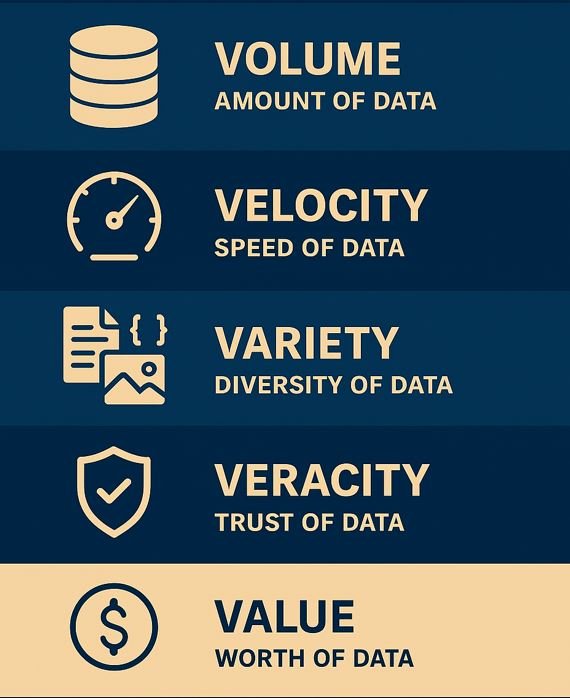
1. Volume — The Scale of Data
Volume refers to the amount of data generated, collected, and stored. With billions of devices, sensors, apps, and systems producing information every second, organisations now manage data at terabyte, petabyte, and even exabyte scale.
Why it matters
- Requires scalable storage like cloud data lakes
- Drives the need for distributed processing (e.g., Spark, Hadoop)
- Enables deeper analytics and AI models that thrive on large datasets
Example:
A global retailer capturing millions of transactions, customer interactions, and inventory updates every day.
2. Velocity — The Speed of Data
Velocity describes how fast data is created, transmitted, and processed. In many industries, real‑time insights are no longer optional — they’re essential.
Why it matters
- Supports real‑time decision-making
- Enables streaming analytics and event-driven architectures
- Powers use cases like fraud detection, IoT monitoring, and live dashboards
Example:
A bank analyzing transactions instantly to detect and block suspicious activity.
3. Variety — The Diversity of Data
Variety refers to the different types and formats of data organisations must handle. Today’s data is no longer limited to structured tables — it spans multiple formats.
Common types
- Structured: SQL tables, financial records
- Semi‑structured: JSON, XML, logs
- Unstructured: Images, videos, emails, documents, audio
Why it matters
- Requires flexible storage and processing tools
- Expands the scope of analytics and machine learning
- Helps organisations capture richer, more contextual insights
Example:
A healthcare provider analysing patient records, medical images, and wearable device data.
4. Veracity — The Trustworthiness of Data
Veracity focuses on data quality, accuracy, and reliability. With massive volumes and diverse sources, data can easily become inconsistent, incomplete, or biased.
Why it matters
- Impacts decision-making and predictive model accuracy
- Requires strong governance, validation, and cleansing processes
- Encourages the use of metadata, lineage, and quality frameworks
Example:
A financial institution ensuring customer data is accurate before running credit risk models.
5. Value — The Business Impact of Data
Value is the most important V — it asks the question:
“What meaningful outcomes can we achieve from this data?”
Data only becomes an asset when it delivers measurable business benefit.
Why it matters
- Drives ROI from data investments
- Aligns analytics with strategic goals
- Encourages prioritisation of high‑impact use cases
Example:
Using customer behaviour data to personalise marketing and increase conversion rates.
Why the Five V’s Still Matter Today
Even as AI, machine learning, and cloud-native architectures evolve, the Five V’s remain a timeless framework. They help organisations:
- Build scalable and resilient data platforms
- Understand the complexity of modern data ecosystems
- Prioritise governance, quality, and business outcomes
- Design analytics and AI solutions that actually deliver value
In a world where data grows exponentially, mastering these fundamentals is essential for anyone working in data engineering, analytics, or digital transformation.
IntelliOpz can help you implement your next big data project. Talk to us today and turn your data into real business value.